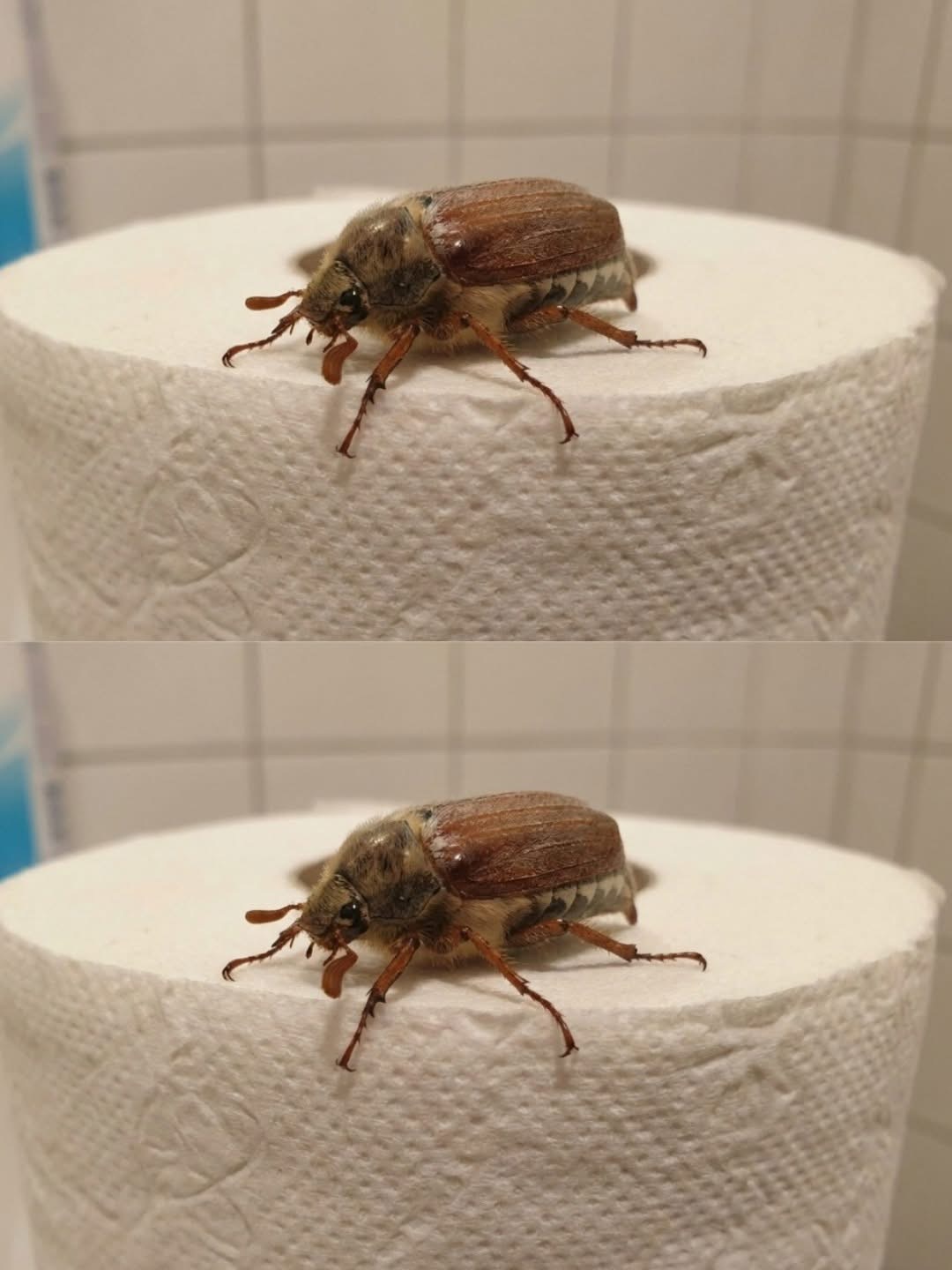
You mentioned you first thought it was a June bug. That’s a very common mix-up. Here’s the quick cheat sheet:
| Feature | Cockchafer (May Bug) | June Bug |
|---|---|---|
| Size | Larger (1–1.5 inches / 25–35mm) | Smaller (½–1 inch / 12–25mm) |
| Color | Dark reddish-brown with a black head | Shiny, metallic greenish-brown |
| Movement | Clumsy, loud, bangs into things | Buzzing, erratic but slightly more agile |
| Active season | Late April through May (4-6 weeks only) | Late May through June |
| Body shape | Stockier, more oval | Slightly sleeker |
The cockchafer is also much louder in flight—hence that alarming “whap” sound you heard. They’re not graceful flyers. At all.
🛠️ What to Do If You Find One (Exactly What You Did Right)
You handled this perfectly. Here’s the simple step-by-step:
1. Don’t panic. They cannot hurt you. Even if one lands on you, it will just crawl or try to fly away.
2. Turn off the bathroom light and close the door. Darkness will calm it down, and it will stop banging into surfaces.
3. Open an outside window (if possible) and turn on an outside light. It will fly toward that light and leave on its own. This is the kindest method.
4. Alternatively, capture it gently. Use a cup and a piece of stiff paper or cardboard. Slide the paper under the cup, carry it outside, and release it onto a tree or bush (not directly on the ground—they need to climb).
What NOT to do:
- Do not squash it (it’s messy and unnecessary).
- Do not flush it (it’s alive and can survive in pipes for a while—cruel and ineffective).
- Do not spray it with insecticide inside your bathroom (overkill and introduces chemicals into your living space).
🏠 Will More Cockchafers Come Inside?
Probably not. The adult flying season is very short (4-6 weeks). You may have one or two more stragglers if you keep your bathroom light on at night with windows open. But they are not breeding or nesting inside your home. They need soil and plant roots for their larval stage, which your bathroom does not provide.
If you want to prevent future confused visitors:
- Keep bathroom windows closed or screened during May evenings.
- Use a lower-wattage bulb or a yellow “bug light” in fixtures near open windows.
- Turn off unnecessary lights at night during cockchafer season.
🌍 A Final Note: Cockchafers Are Actually Good for the Garden
As an adult, the cockchafer eats leaves (which can annoy gardeners). But as a larva (grub), it aerates soil and breaks down organic matter. More importantly, they are a vital food source for bats, birds, and hedgehogs.
Their population crashed in the 20th century due to pesticides. They’ve been making a comeback, and many ecologists see this as a positive sign for biodiversity. So your late-night visitor was not just a clumsy bug—he was a small sign that local ecosystems are recovering.
🗝️ The Bottom Line
| Question | Answer |
|---|---|
| Is it dangerous? | No – safe for humans and pets. |
| Will it bite? | No – it has no interest in you. |
| Is my house infested? | No – this was a lost, single adult. |
| Should I call pest control? | No – it’s an outdoor insect, not a pest. |
| What do I do? | Turn off the light, open a window, or gently cup and release outside. |
You survived a cockchafer encounter. It’s not bad luck. It’s not a sign of a dirty home. It’s just one of nature’s clumsiest, loudest, and most harmless spring visitors taking a wrong turn toward your toothbrush.
And honestly? That’s a much better story than “I found a roach.”
If you see another one tonight, smile, turn off the light, and let it find its way back outside. You’ve got this. 🪲